Alura Flores de Angeles and the Love Story behind the Jarabe Tapatio

Alura Flores de Angeles

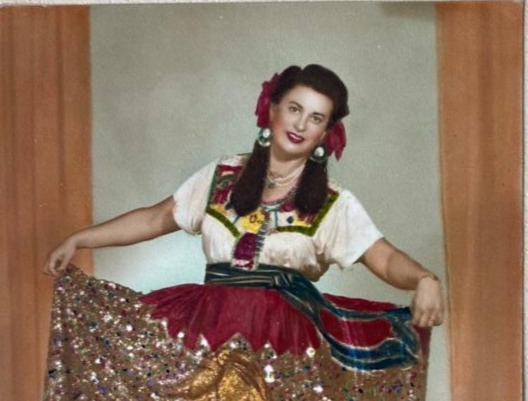
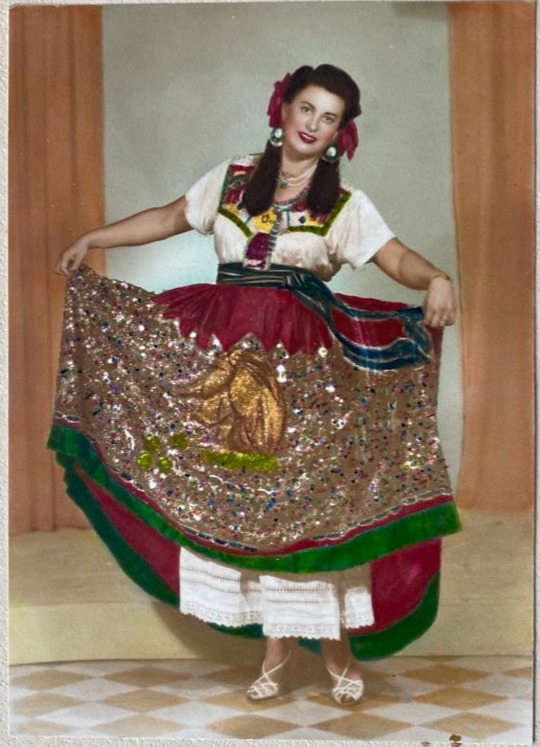
Alura Flores de Angeles “Godmother of Mexican Dance” was a woman who was not of my generation. I only heard stories of her teachings, insights, and dances as taught to me by my aunt Sanjuanita Martinez-Hunter Ph.D. My aunt would tell me that she invited Flores de Angeles to speak and teach at the University of Texas at Austin in 1979, 1982, and 1988. To think that I only missed meeting her by two years since I did not begin my studies at the University of Texas until 1990. I learned Flores de Angeles’ version of the Jarabe Tapatio, the national dance of Mexico, from my teacher Roy Lozano, who was a student of my aunt and attended Flores de Angeles’ workshop in 1979. I also learned this dance from my aunt. My aunt told me that Flores de Angeles taught her the gendered love story surrounding a performance of the Jarabe Tapatio.

The Jarabe Tapatio and Love Story

The Jarabe Tapatio is performed by the Mexican cowboy (the Charro), and the Mexicana woman (China Poblana). The most famous part of this dance is when the charro throws his sombrero on the floor and the couple dances around it.
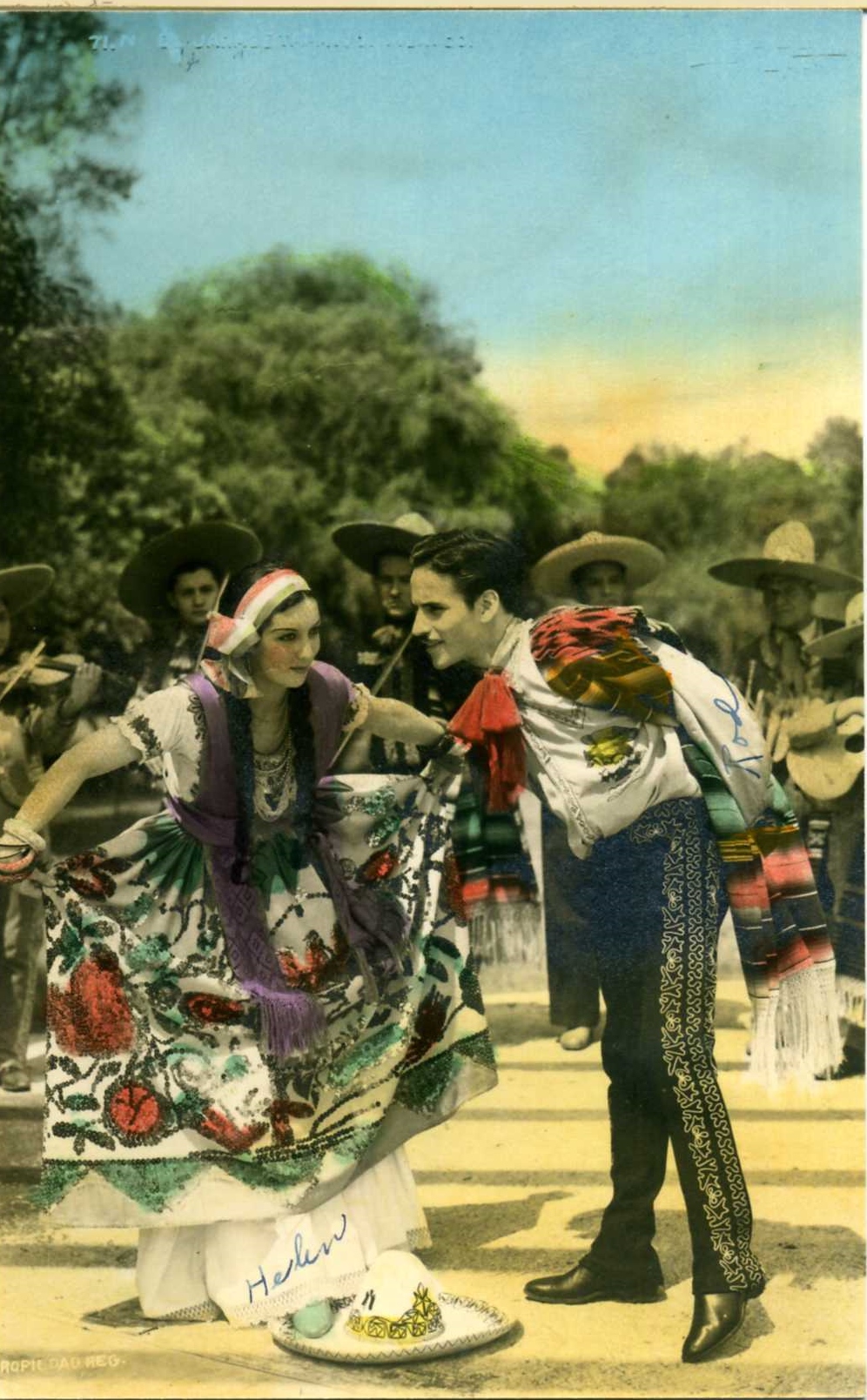
Flores de Angeles passed on a love story behind the Jarabe Tapatio every time she taught it. I will utilize Flores de Angeles’ written words as printed in the April/May issue of Real Mexico in 1934, as well as workshop notes documented by Folklorist Ron Houston to narrate the love story behind the Jarabe Tapatio.

Flores de Angeles says, “Now the explanation of the meaning of the dance. There are eight steps, quite intricate ones. The first step represents the galloping of a horse. The charro, booted and spurred, is on his way to the china’s house. In the second step he rasps briskly at the door but it is not opened to him because the china is not in. In the third step the charro walks across the corral in order to take his horse from the stable, and on the way, in the fourth step, he meets the china poblana. She coquets with him, but keeps him at arms’ length. The fifth step shows the charro drunk-probably to drown his sorrow. He is unable to guide his horse straight as the sixth step indicates (Flores de Angeles 1934, 17).

Fearing her father would see the charro drunk, the china poblana serves him hot tea to sober him up. They both perform the footwork sequence known as the hojas de té (Houston 2017, 50).

The china poblana is touched. She turns toward the charro and the two start to flirt again. The charro signifies that he is all hers by throwing his hat on the floor. The china in order to accept him takes the chic method of dancing on the broad brim of the hat (Flores de Angeles 39) or by either placing the hat on her head (Houston 2017, 51).

In the eighth and last step, both are hilariously merry and express their pleasure and happiness by dancing “La Diana” (Flores de Angeles 1934, 39).

[They] both hide behind the hat and kiss, as they are now engaged (Houston 2017, 51). This, then, is the story of the Jarabe Tapatío, Mexico’s national dance, which …. is now known to all the world interested in dancing (Flores de Angeles 1934,39).”

Performing the Love Story

My aunt Sanjuanita Martinez-Hunter and her student Roy Lozano performed Flores de Angeles’ version of the Jarabe Tapatio in the 1970s for Austin Cable Television. Please see the videoclip below where I narrate Flores de Angeles’ love story. (Video courtesy of Michael Carmona.)

Jarabe Tapatio with Roy Lozano and Sanjuanita Martinez-Hunter Ph.D.

To learn more of the life of Alura Flores de Angeles and the love story of the Jarabe Tapatio, please read my article called “Unraveling State-Sanctioned Gender Roles and Reclaiming Histories: Alura Flores de Angeles’ Jarabe Tapatío” in Dance Chronicle, volume 49, issue 1, February 2026. Click on the link below to read it.

Works Cited

Cable Arts Festival, “The Jarabe Tapatío,” narrated by Melvin Elps, aired in the 1970s, on Austin Cable Television (ACTV)

Flores Barnes and Jeanne Maisonville. 1934. “The Dances.” Real Mexico. 3(15): 16-17, 39.

Houston, Ron. 2017. Folk Dances of Mexico for Grupos Folklóricos: Dances Introduced by Alura Flores and her Students. Austin: Society of Folk Dance Historians.

Copyright March 24,2026
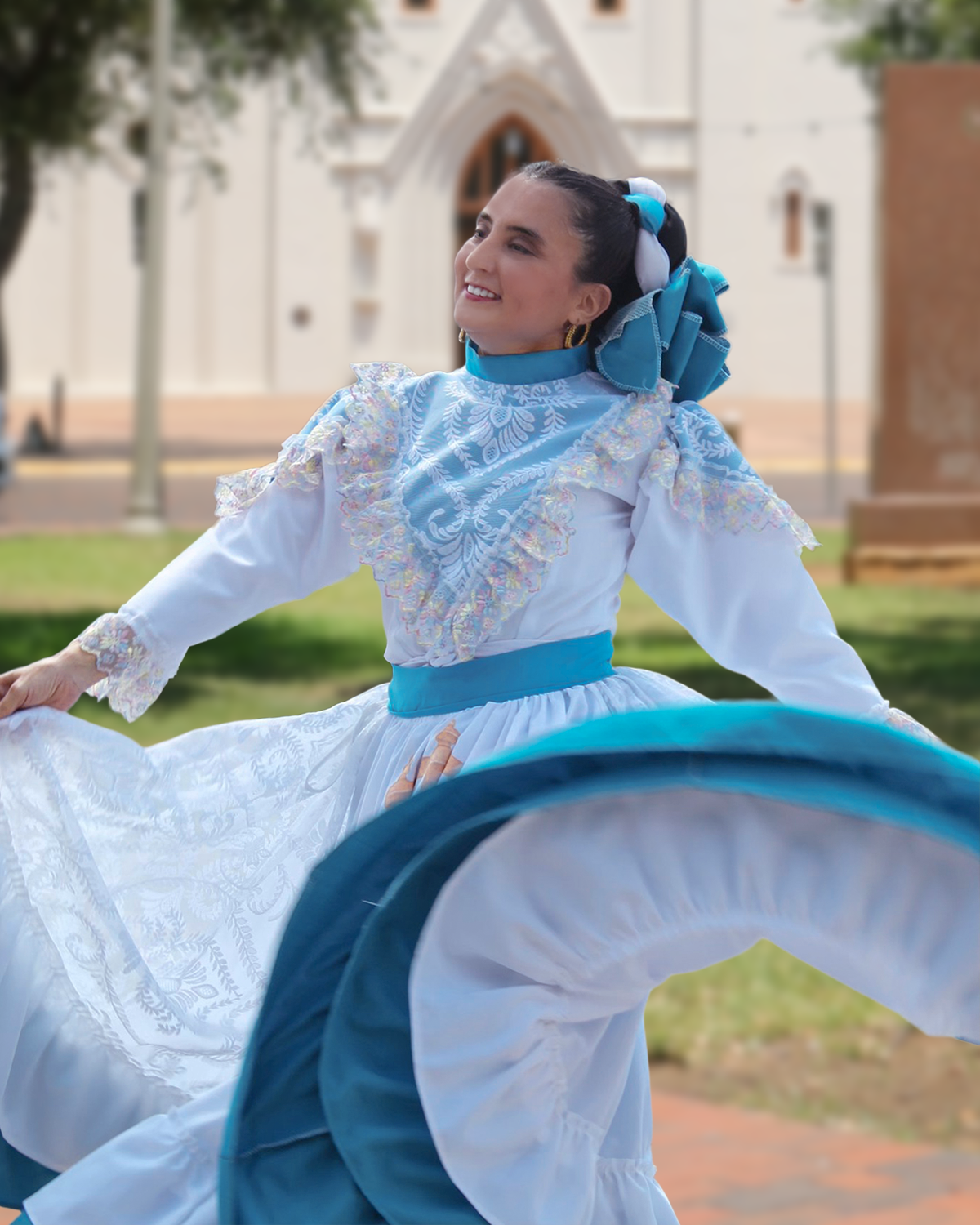
Gabriela Mendoza-Garcia Ph.D. is a folklorista or one who researches, teaches, and performs Mexican folklórico dance. She has over thirty years of training and experience teaching folklórico. Mendoza-Garcia earned a doctoral degree in Critical Dance Studies from the University of California, Riverside. Upon graduation she began her own folklórico dance school and company in Laredo, Texas, called the Gabriela Mendoza-García Ballet Folklórico. Mendoza-Garcia teaches children and adults of all ages folklórico. She teaches traditional Mexican folklórico dance pieces, as well as works that are inspired by her scholarly research and vice versa. Her most recent publications include a children’s book called Todos a Bailar! A Folklorico Alphabet Book, an article in Dance Chronicle called “Unraveling State- Sanctioned Gender Roles and Reclaiming Histories: Alura Flores de Angeles’ Jarabe Tapatío,” a chapter entitled “Las Adelitas: Choreographing Mexicana Gender Equity while Embodying Chicana Feminism” in the forthcoming book Folklorico in the United States: Unwritten Histories, and the History & Folklore documentary with an accompanying booklet by the Webb County Heritage Foundation.


Jalisco

Nationalization of Folklórico Dance

Imagine this….you are the President of Mexico, Álvaro Obregón (1920-1923), your country survived a bloody revolution. In fact, you still have to quell a few up-risings here and there. Your countrymen and women identify more with their region than with the nation. You realize that your people need to unite culturally and politically. They must identify with the nation of Mexico. What do you do?

A Bit of History

To solve this dilemma, Obregón appointed José Vasconcelos to serve as the Secretary of Public Education (1920-1924). Not only was Vasconcelos instrumental in helping combat illiteracy, he also began the Cultural Nationalist Movement. What better way to unite the country than through music and dance? Vasconcelos wanted to be sure that every child enrolled in public school was taught folkloric dances. So, he started programs to train Physical Education teachers to teach Mexican folklórico dances. Vasconcelos even developed the Cultural Missions whereby a team of teachers including a Physical Education teacher would travel to a rural area in Mexico to teach. They were also instructed to document and collect the dances of the rural people (Mendoza-Garcia 324-329). What happened as a result of this emphasis?

The result was an officially sanctioned vision of Mexico that was supported by folklórico music and dances designated to represent the nation. Ricardo Pérez Montfort in Avatares del Nacionalismo Cultural: Cinco Ensayos (2000) argues that the national culture defined “Mexicanness” as coming from the pueblo. In the 1920s, the pueblo was thought of as being rural, provincial, poor, marginalized, yet experienced by the majority. Education was the key to consolidate and modernize the pueblo, and thus the nation itself. In addition, Pérez Montfort suggests that the use of the image of the pueblo became synonymous with the stereotyped image of “Mexicanness” which was invoked by the political leaders of Mexico to legitimize public policy (Avatares 35-45; Estampas 113). Rural Mexico was invoked in the music of the Mariachi band, as well as in the popular songs such as huapangos, corridos, and sones that are accompanied by the indigenous and folkloric dances (Sáenz 20-23). Folklórico flourished under this romanticized, idealized vision of Mexico.

Picking the Dances to Represent

Pablo Parga in Cuerpo Vestido de un Nación. Danza Folklorica y Nacionalismo Mexicano (1921-1939) (2004) argues the elites specifically chose which dances were to represent the regions of Mexico. In fact, they designated the Jarochos to represent Veracruz, the huapangos to represent the huasteca region, as well as, the charro and china poblana to represent the nation. Thus, many of our beloved folklórico dances that we perform to were actually hand-picked to represent the nation. In fact, Alura Flores de Angeles “Godmother of Mexican Dance” (1905-2000) indicated to folklorist Ron Houston that in 1924 the Secretaría de Educación Pública (SEP) established a committee to standardize the Jarabe Tapatío. The committee chose the steps, music, and sequence of motifs of the Jarabe Tapatío which would be taught to school children. Furthermore, in her accounts of the history of the Jarabe Tapatío, Flores de Angeles states that in 1924 the Mexican government commissioned the SEP to synthesize the much shorter two and a half minute Jarabe Tapatío from the six minute version of the Jarabe Largo Ranchero. She indicated that she was a part of this committee (Mendoza-Garcia 323). Thus, much of what we know as folklórico today was born out of these ideas of what dances should represent the nation.

China Poblana
China Poblana in 2020 in the United States

Parga notes that an unofficial version of Mexican music and dance remained within the pueblo. This unofficial version stands in opposition to the official sanctified ideas promoted by the state. He suggests that when the nation began to nationalize the folklórico dances of Mexico, a “it has to be this way” kind of thinking developed. Parga remarks that believing that the dances ” has to be this way” developed from the elites who picked the dances to represent Mexico. He argues it is very centralistic and patriarchal way of thought.

My Ideas

I am very intrigued by the ways in which folklórico dance was nationalized by the state. I ask the following questions. What dances were chosen and why? Who gets left out of this official narrative? What gets erased?  What is the political reason behind this? Montfort argues that it is time to re-envision what dances belong to the nation (Breves Comentarios 192). What do you think?

Works Cited

Mendoza-Garcia, Gabriela. 2016. “The Jarabe Tapatío: Imagining Race, Nation, Class, and Gender in 1920s Mexico.” edited by Anthony Shay and Barbara Sellers-Young, 319-342. Oxford University Press.

Parga, Pablo. 2004. Cuerpo Vestido de un Nación. Danza Folklorica y Nacionalismo Mexicano (1921-1939).  Mexico: Conalculta/fonca.

Pérez Montfort, Ricardo. 2005. “Breves Comentarios al Libro Cuerpo Vestido de Nación.” Desacatos. 19: 189-192.

—.—. 2000. Avatares Del Nacionalismo Cultural: Cinco Ensayos. Mexico, D.F.: CIDHEM.

 —. —. 1994. Estampas Del Nacionalismo Popular Mexicano: Ensayos Sobre Cultura Popular Y Nacionalismo.” Mexico,D.F.: Centro de Investigaciones y Estudios.

Sáenz, Moisés. 1939. Mexico Integro. Peru: Imprenta Torres Aguirre.

Photos courtesy of Gabriela Mendoza-Garcia

Copyright, October 4, 2020, Mendoza-Garcia

Gabriela Mendoza-García Ph.D. is an Artist and Scholar. She has her own dance school and company called the Gabriela Mendoza-García Ballet Folklórico in Laredo, Texas.  Dr. Mendoza-Garcia founded this group in 2013 and teaches children and adults of all ages. Her company consists of seasoned folklórico dancers with years of experience performing this art form. She teaches traditional Mexican folklórico dance pieces, as well as, works that are inspired by her scholarly research. Her scholarship includes: Dancing throughout Mexican History (1325-1910), History & Folklore booklet with an accompanying documentary sponsored by the Webb County Heritage Foundation, The Jarabe Tapatío: Imagining Race, Nation, Class and Gender in 1920s Mexico published by Oxford University Press, an on-line blog, writings for Asociación Nacional de Grupos Folklóricos, and others.