Gabriela Mendoza-Garcia Ballet Folklorico Juvenil

A Note to Folkloristas–We Will Persevere

I could never have imagined the position that we are in–never in my wildest dreams. It began with me seeing all the postings on Facebook of my colleagues in California cancelling their concerts, classes, and even events. I noticed my friends in other states began to do the same. In Texas, Governor Abbot declared that all public schools would be closed until April 3rd. That is when it hit home! I suspended all my dance classes. I began to share warm-up exercises, zapateado techniques, and even host a few Facebook live on-line classes just so that we wouldn’t completely stop dancing folklórico entirely.  I had to re-think this entire situation. And these are my thoughts.

Aztec Codex Borgia
Aztec Codex Borgia

We come from a very strong people. Our people have overcome conquest, colonization, and even genocide. We adapted and survived the European colonization of the Americas, the Spanish inquisition, the War of Independence from Spain, the Reform Wars, the Mexican-American War, the Mexican Revolution, etc. In the United States, our people are both native people and immigrants to this country. We struggled and fought in many wars such as the American Revolution, American Indian Wars, the Mexican-American War, the Civil War, World War I, World War II, the Korean War, the Vietnam War, the Iraq War, the Gulf War, etc. We protested and fought for our civil rights during the Chicano Movement. We continue this fight even today. Our music and dance traditions continuously transform. They are inspired by the political events around us. We did not stop dancing in times of hardship. During the Spanish Inquisition, our people were punished with three hundred lashes with a whip, fined, and put in jail for singing and dancing the jarabes. This did not stop us from playing our music, singing our songs, and dancing.

Jarabes during the Colonial Era

Our people survived small pox which killed millions of indigenous people throughout the Americas in the 1500s. In Tenochtitlán approximately 150,000 died of small pox. We are the survivors of the measles, syphilis, influenza, etc. Throughout this decimation our ancestors continued dancing. Perhaps the reason we express so much joy in our dances is because our people turned to music and dance as a survival mechanism. Think about it, for a few hours they could leave their problems behind them while they danced. We should do the same

So, we shall too overcome this pandemic. As Folkloristas we are the storytellers, the shamans, the bearers of our cultural dance traditions in the twenty-first century. We will adapt, change, and continue dancing just as our ancestors before us. We will persevere!

Cover photo courtesy of Gabriela Mendoza-Garcia. Photos are in the public domain.

Copyright, 3/29/2020, Mendoza-Garcia

Gabriela Mendoza-García Ph.D. is an Artist and Scholar. She has her own dance school and company called the Gabriela Mendoza-García Ballet Folklórico in Laredo, Texas.  Dr. Mendoza-Garcia founded this group in 2013 and teaches children and adults of all ages. Her company consists of seasoned folklórico dancers with years of experience performing this art form. She teaches traditional Mexican folklórico dance pieces, as well as, works that are inspired by her scholarly research. Her scholarship includes: Dancing throughout Mexican History (1325-1910), History & Folklore booklet with an accompanying documentary sponsored by the Webb County Heritage Foundation, The Jarabe Tapatío: Imagining Race, Nation, Class and Gender in 1920s Mexico published by Oxford University Press, an on-line blog, writings for Asociación Nacional de Grupos Folklóricos, and others.


Five Historical Facts about Las Adelitas or Las Soldaderas

Adelita is a nickname given to women soldiers or soldaderas who fought along side men in battle during Mexico’s Revolutionary War (1910-1920). Many of us depict these brave women when we perform the dances of La Revolución. I first learned La Revolución as a dancer with Roy Lozano’s Ballet Folklórico de Tejas in the 1990s. Roy Lozano, my teacher, passed on the choreographies that he learned from performing with the Ballet Folklórico de México de Amalia Hernández in the late 1970s. Following this dance tradition, I have taught these dances to my own company which have been in our own repertoire since 2003. Yet, I feel that our folklórico practice encourages a romanticized view of the las adelitas. Quite recently, I began to deep deeper into historical accounts and realized that there was so much that I didn’t know.  

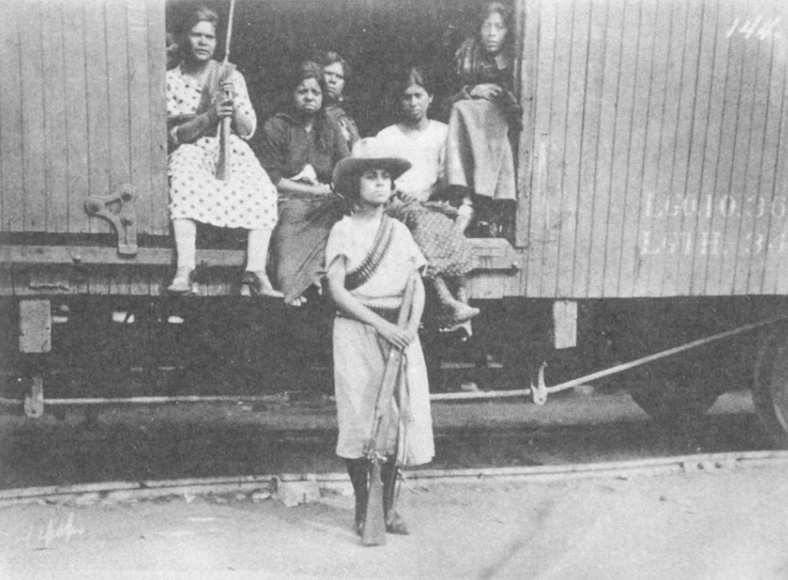
  • 1. The word soldaderas refers to women who followed men in camp and those who fought in battles. During Mexico’s Revolutionary War, soldiers paid women to work on their behalf as servants. These women purchased supplies, cleaned clothes, cooked, cared for the sick, buried the dead, and some were prostitutes. Many women were expected to follow their husbands, fathers, brothers, lovers, etc. into the military. Yet, others fought in battle as soldiers, generals and colonels. They lead militias of men and women troops to fight during the Revolution (Salas 1990, xii, 44; Monsiváis 2006, 5).
Soldaderas as Camp Followers
  • 2. Not all women willingly followed men in battle. Some were abducted and raped. There are stories of young girls been taken from their homes and forced to follow the troops while their mothers cried at home. Newspaper accounts tell of women kidnapped on trains and even one reports that forty women, almost the entire female population from the village of Jojutla, were abducted by Zapatistas. Nuns were taken from their convent and forced to accompany the Carrancistas. After the war, many of these nuns were pregnant or had children of their own. Parents fought back by hiding their children in the fields, posting look outs for revolutionaries, disguising their daughters etc. (Salas 1990, 40-42).
Soldaderas during the Mexican Revolution
  • 3. Women were so very brave. They lead regiments of men in battle as colonels and generals. They also led regiments comprised entirely of women in battle. Women were sent on secret spy missions, brought ammunition to men while dodging bullets during the line of fire, and some were so courageous that they were feared and respected by men (Salas 1990, 41-43).
Soldadera on Horse
Soldadera on Horse
  • 4. As we dance Las Adelitas we wear cartridge belts around our torso, carry rifles and use a serious expression to portray these tough, courageous women. We wear skirts and blouses typical of the time period. Yet, some soldaderas dressed as men. They wore pants, shirts, or even dressed in men’s military uniforms. See pictures below.
Soldadera posing for the camera
Soldadera  Posing
Carmen Robles, Soldadera
  • 5. After the Mexican Revolutionary War, women’s military contributions were devalued. Women were not called colonels or soldiers but were listed under the general term of soldaderas. The military classified soldaderas as wives. Very few women veterans received military pensions. Most did not. Women who did receive pensions could not re-marry nor officially participate in the military (Arce 2017, 65, 82). In addition, after the Revolution, images of the soldaderas were romanticized in literature, film, art, and song. Soldaderas were not depicted as diverse, independent women many of which fought in battle but instead they were cast along four main stereotypes.  Soldaderas were characterized as either self-sacrificing, sexually carefree, sweethearts, or soldiers (Salas 1990, 69, 82).

My Thoughts

I have danced and taught the choreographies that represent La Revolución for years.Yet, I believe that a close study of history alongside our folklórico practice really allowed me the ability to fully appreciate the individual spirit of these brave and courageous women.

Written by Gabriela Mendoza-Garcia Ph.D.

Works Cited

Arce, Christine.2017. México’s Nobodies: The CulturalLegacy of the Soldadera and Afro-Mexican Woman. Albany: State University ofNew York.

Monsiváis, Carlos.2006. “Foreword.” In Sex in theRevolution: Gender, Politics, and Power in Modern Mexico, ed. JocelynOlcott, Mary Kay Vaughn, and Gabriela Cano. 1-20. Durham: Duke University Press.

Salas, Elizabeth. 1990. Soldaderas in the Mexican Revolution: Myth and History. Austin: The University of Texas Press.

FurtherReading

Craske, Nikki. “Ambiguities and Ambivalences in Making the Nation: Women and Politics in 20th Century Mexico.” Feminist Review.79 (2005) 116-133.

Olcott, Jocelyn, Mary Kay Vaughn, and Gabriela Cano. 2006. Sex and the Revolution: Gender,  Politics, and Power in Modern Mexico. Durham: Duke University Press.

Poniatowska,Elena, 2016. Hasta no verte Jesús mío.Madrid: Alianza Literaria.

Schaefer, Claudia. 1992. Textured Lives: Women, Art, and Representation in Modern Mexico. Tucson: The University of Arizona Press.

Turner, Frederick C. 1967. “Los Efectos de la Participación Femenina en la Revolución de 1910.” Historia Mexicana. 16 no. 4 (April-June): 603-620.

All photos are in the public domain.

Copyright, 1/6/2019, Mendoza-Garcia

Gabriela Mendoza-García Ph.D. is an Artist and Scholar. She has her own dance school and company called the Gabriela Mendoza-García Ballet Folklórico in Laredo, Texas.  Dr. Mendoza-Garcia founded this group in 2013 and teaches children and adults of all ages. Her company consists of seasoned folklórico dancers with years of experience performing this art form. She teaches traditional Mexican folklórico dance pieces, as well as, works that are inspired by her scholarly research. Her scholarship includes: Dancing throughout Mexican History (1325-1910), History & Folklore booklet with an accompanying documentary sponsored by the Webb County Heritage Foundation, The Jarabe Tapatío: Imagining Race, Nation, Class and Gender in 1920s Mexico published by Oxford University Press, an on-line blog, writings for Asociación Nacional de Grupos Folklóricos, and others.


Dancing Throughout Mexican History (132-1910)

How do Folklorico Dancers Embody the Son?

 The Son -Mexico’s  Dance                                                                                                  

Mestizo folk music was born from the blend of the Indigenous and Spanish cultures in Mexico. In the seventeenth century, a new variety of generic song and dance, the son (peasant song) appeared. (Scholars today acknowledge the son as having mestizo, Indigenous, and African influences). As the son became popular, those sones which were native to a particular locale were called sones de la tierra. By the nineteenth century, sones were identifiable as typically Mexican. Sones are popularly sung and danced throughout Mexico. The huapango, the jarana, the Chilean son, the son jarocho, and the jarabe are all sones which stem from the Spanish zapateado steps, dances, and music. Most sones developed from Spanish peasant or rural music. A son differs from other music in its “form, rhythm, choreography, and textual content.” Its characteristic “unequal triple rhythm” is based on “patterns of six beats.”

Dancing to a Son
Independent couples dance sones, many of which are distinguished by the rapid action of the feet in a zapateado. The zapateado serves as accompaniment to the music when the rhythm of the dancers’ feet produce percussion-type sounds. The zapateado’s percussive accompaniment and many of the melodic instruments, such as the violin, stop while the lyrics of the son are sung. A zapateado produces its sound by the fast stamping of the feet on hard ground or on a raised wooden platform called a tarima. As “one of the universal traits of the son,” the zapateado is also a particular kind or type of son. Many of the sones from southern Mexico which are accompanied by marimba music are generally known as zapateados. Many of these belong to the repertory of sones de marimba or sones istmeños.

Lyrics of a Son
Lyrics for sones are usually written in rhyming couplets with eight-syllables in each line. The son usually opens with a dedication of the performance either to the gracious audience, to a particular important individual in the audience, or to beauty in individuals or in nature. The couplets of the sones often weave colorful tapestries of men and women in love surrounded by the beauties of nature. Malageña, a love overture to a girl from Malaga in Spain; Petenera, a tragedy about sailors set to unusually lively rhythm; and Indita, a description for the passion of Indigenous women are three typical sones that are appropriate for singing only.
In this book, Martinez-Hunter continues to describe the different types of dances that sones are performed to. These include the chilena, huapango, son jarocho, jarana, and the jarabe.

My Thoughts                                                                                                                                      

The sones and jarabes are still popular even today in the 21st century. We dance sones and jarabes from the states of Nayarit, Tamualipas, Jalisco, Veracruz to name a few.  A few of us living in the United States even create our own choreographies to the sones of Mexico.

Photos courtesy of Gabriela Mendoza-Garcia

Copyright, 10/14/2018, Mendoza-Garcia

Gabriela Mendoza-García Ph.D. is an Artist and Scholar. She has her own dance school and company called the Gabriela Mendoza-García Ballet Folklórico in Laredo, Texas.  Dr. Mendoza-Garcia founded this group in 2013 and teaches children and adults of all ages. Her company consists of seasoned folklórico dancers with years of experience performing this art form. She teaches traditional Mexican folklórico dance pieces, as well as, works that are inspired by her scholarly research. Her scholarship includes: Dancing throughout Mexican History (1325-1910), History & Folklore booklet with an accompanying documentary sponsored by the Webb County Heritage Foundation, The Jarabe Tapatío: Imagining Race, Nation, Class and Gender in 1920s Mexico published by Oxford University Press, an on-line blog, writings for Asociación Nacional de Grupos Folklóricos, and others.